

Refining advanced dental skills without support often results in slow progress and unnecessary frustration. Personalized mentorship addresses this by providing immediate feedback and focused support, helping you improve more quickly. Select advanced dental continuing education institutions, including IDEA, structure hands-on courses around individualized instruction and real-time faculty feedback. In this article, we highlight how one-on-one guidance speeds mastery and enhances technical competence.
Why Mentorship Is Critical in Dental Education
Dental procedures involve complex procedures, precise instrumentation and techniques, and high-stakes decision-making. Small errors can compromise patient outcomes or require costly rework. The margin for error is narrow, and the consequences of poor technique extend beyond a single appointment. Mentorship addresses the gap between knowing what to do and doing it correctly.
IDEA’s Endodontics Hands-on Course exemplifies this approach with a 4-day mini-residency focused on proper endodontics and managing complex root canal systems where training is tailored to the individual whether beginner, wanting to get back into endo, or the seasoned endodontic vet. Instructors work directly with participants to develop the precision needed for challenging cases.

Seven Ways Direct Guidance Fast-Tracks Mastery
Personalized mentorship helps you advance your skills through several interconnected methods. Each contributes to quicker, more reliable improvement. These factors explain why one-on-one guidance makes dental continuing education more impactful.
Eliminates Trial-and-Error Learning
Without guidance, you test approaches until something works. That process wastes time and embeds inconsistent methods. You might complete a procedure successfully but not know which steps were essential and which were unnecessary detours.
A mentor shows you the correct technique immediately, so you practice the right way from the start. There’s no need to unlearn bad habits later. You build efficiency from day one instead of discovering it through repeated mistakes.
Identifies Weaknesses You Don’t See
You can’t observe your own hand position, body mechanics, or timing while you’re focused on the procedure. Your attention is on the patient and the immediate task. Subtle inefficiencies go unnoticed because you lack an external perspective.
A mentor watches your technique from multiple angles and points out issues you’d never catch on your own. They see when your wrist position creates unnecessary strain or when your instrument angle reduces control. This awareness prevents compensation patterns that slow progress and limit what you can achieve.
Provides Immediate Course Correction
Timing matters when learning motor skills. The sooner you adjust an incorrect movement, the less likely it becomes automatic. Waiting until after a procedure to review what went wrong means you’ve already reinforced the error multiple times.
A mentor corrects your approach in the moment, not after you’ve repeated it incorrectly. They interrupt before the wrong pattern sets in. This prevents muscle memory from locking in movements that work against accuracy.
Customizes Training to Your Skill Gaps
Some practitioners struggle with hand steadiness. Others have trouble with visualization or case selection. Generic instruction doesn’t account for these differences. It treats every learner as if they’re starting from the same place with the same challenges.
A mentor tailors instruction to your specific needs instead of delivering the same lesson to everyone. They identify where you’re strong and where you need focused practice. You spend time on what you actually need to improve, not working through material you’ve already mastered.
Ensures Consistent Technique
Reproducing a skill across different cases requires standardization. Patient anatomy varies. Clinical conditions change. But your approach should remain reliable regardless of those factors.
A mentor reinforces the same method each time, helping you develop a process that works across situations. They catch when you start adapting technique in ways that introduce variability. Consistency leads to predictability, which is what separates competent practitioners from inconsistent ones.
The Periodontal & Peri-Implant Plastic Microsurgery course at IDEA focuses on developing standardized microsurgical protocols that enhance predictability and esthetics across all periodontal and implant procedures.
Builds Confidence Through Direct Feedback
Hesitation slows you down and increases errors. When you’re unsure whether you’re executing correctly, you pause, second-guess, and move tentatively. That mental friction disrupts flow and makes procedures take longer than necessary.
When a mentor confirms you’re doing something correctly, you stop questioning yourself. You move through steps with certainty. That reassurance improves your execution by removing the cognitive load of doubt.
Reduces Emotional Strain and Professional Burnout
Advanced procedures carry emotional pressure alongside technical demands. Performing complex treatments without reassurance or guidance can lead to isolation, stress, and self-doubt, especially when outcomes feel uncertain. Over time, this strain contributes to burnout and disengagement from clinical growth.
Mentorship provides more than technical correction. It offers professional reassurance and shared responsibility in the learning process. Knowing an experienced clinician is actively supporting your development reduces mental fatigue and restores confidence. This support helps practitioners stay engaged, motivated, and focused as skill demands increase.
Transfers Clinical Judgment and Decision-Making
Technical execution is only part of the equation. Knowing when to proceed, when to pause, and how to adapt to unexpected findings requires experience you can’t get from a textbook. Protocols tell you what to do, but they don’t teach you how to think through complications.
A mentor shares the reasoning behind their decisions. They explain why they chose one approach over another in a specific case. You learn to evaluate risk, weigh options, and make judgment calls based on factors that aren’t always obvious. That framework for thinking through complex cases is what separates skilled technicians from clinicians who can handle anything.
For example, IDEA’s Immediate Dental Implants course teaches practitioners modern implant concepts with emphasis on clinical decision-making. It focuses on tissue preservation, minimally invasive techniques, and how to evaluate cases for optimal esthetic success.
Also Read: Master Programs vs. Modular Courses: What’s Best for Your Dental Career?
Group Learning vs. One-on-One Instruction: What Works Better
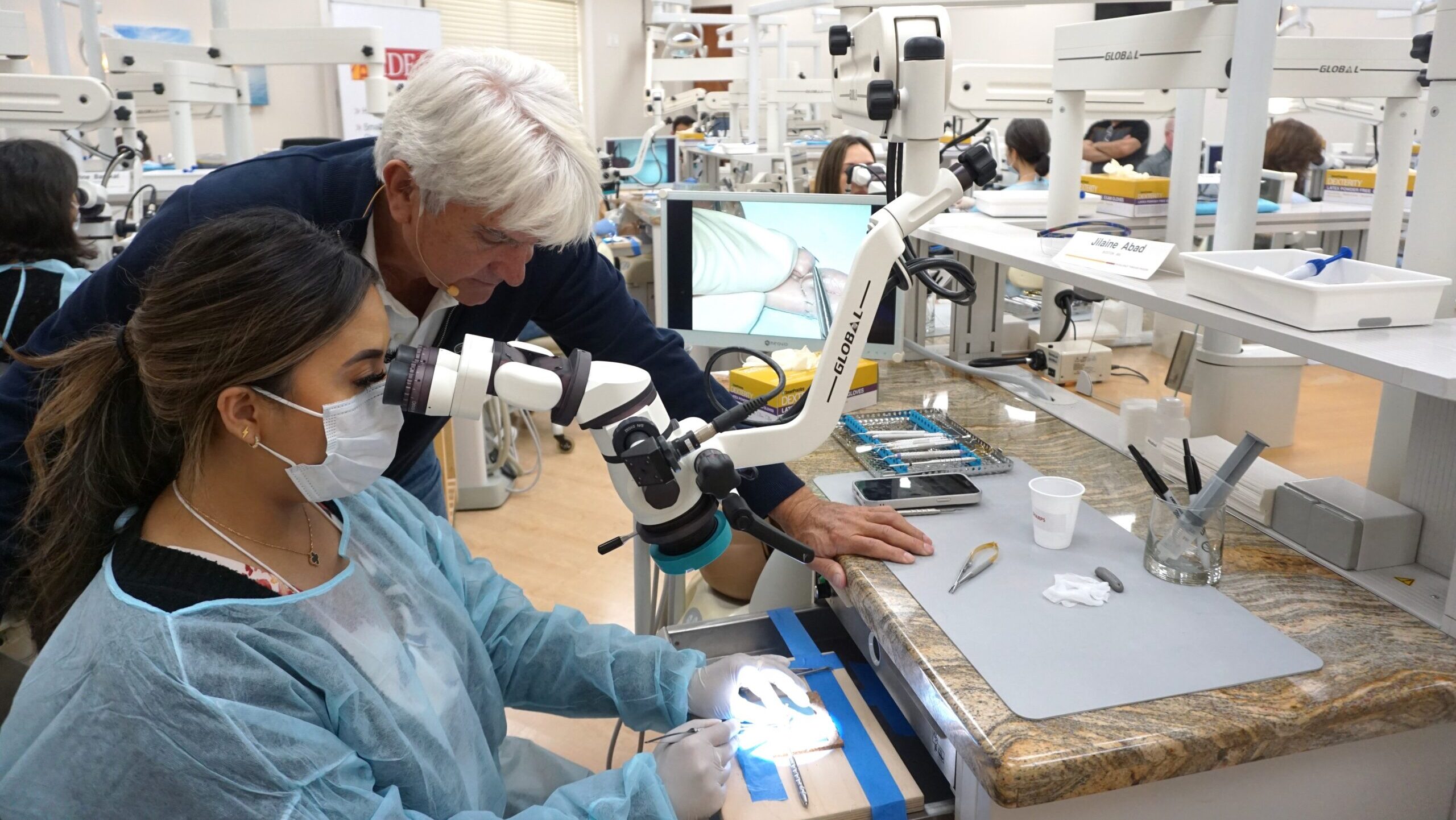
Group settings work well for theory and discussion. They create opportunities to learn from others’ questions and hear different perspectives. But they’re less effective for hands-on skill development. In a group, the instructor divides attention across multiple participants. They can’t watch everyone simultaneously. Feedback is general rather than specific to your technique.
One-on-one instruction gives you dedicated time to practice, ask questions, and refine your approach without waiting for others. The mentor focuses entirely on what you’re doing. They catch small issues immediately instead of after the session ends. You get as much repetition as you need without feeling rushed or holding others back.
Read More: Branding Yourself as a High-Level Clinician in a Competitive Dentistry Market
Finding Quality Mentorship in Dental Continuing Education

Not all dental CE courses allow you to actually practice and apply advanced techniques. Choosing a program that emphasizes hands-on work with experienced instructors makes a real difference in what you can do clinically. IDEA delivers dental CE courses where you work directly with top international faculty in a setting built for focused, practical learning.
Effective mentorship does not begin on the first day of a course or end when training concludes. IDEA emphasizes continuity through structured pre-course preparation and post-course support. Participants enter with clearer expectations and foundational knowledge, allowing in-person time to focus on execution rather than orientation. After the course, continued access to faculty guidance and case review supports refinement as techniques are applied in real clinical settings.
Key aspects that make us stand out include:
- Individual attention: Mentors work directly with you, observing technique and providing corrections in real time to ensure each step is executed correctly.
- Small groups (max. 16 participants): Limited class sizes allow instructors to focus on every participant, so no one is overlooked.
- Exceptional faculty ratio:
16 participants is only half of the story. Every course is staffed with multiple instructors, achieving a 1:8 or better instructor-to-student ratio. This means constant chairside mentoring, immediate feedback, and meaningful one-on-one moments throughout every hands-on session. - Teaching ability: Faculty clearly explain the reasoning behind every procedure, helping participants understand why each technique works.
- Intense hands-on training: Participants perform procedures repeatedly, building familiarity with instruments, materials, and clinical workflow.
- World-renowned international faculty: Learn from global dental leaders who bring advanced techniques and the latest clinical insights.
- 4-day immersive courses: Extended sessions provide time to fully practice, troubleshoot, and apply techniques in a realistic setting.
- State-of-the-art facility: IDEA’s training center has 16 simulation lab stations, each equipped with microscopes, instruments, mannequins, and all materials needed to replicate a real chairside environment.
- Independent, pure teaching: IDEA fully funds all course expenses to keep the education free from corporate influence, ensuring focus is entirely on clinical learning.
IDEA’s CE courses are comprehensive and thoughtfully structured. Every program includes an all-inclusive package with hotel, local transportation, and meals prepared by an in-house chef. You can gain access to international expertise and learn techniques rooted in biological and scientific evidence. Call IDEA today to speak with the team and learn how our courses are structured for in-depth training.
