
Evidence-based strategies for cusp fractures, cracked tooth syndrome, and biomechanically fragilized teeth, and where dentists can learn the most advanced adhesive protocols.
Cracked teeth are among the most challenging problems in restorative dentistry. The symptoms can be vague, crack patterns unpredictable, and treatment decisions highly dependent on biomechanics, remaining tooth structure, and long-term restorative strategies.
Modern adhesive dentistry has transformed how we diagnose and treat cracked teeth, but only if we understand exactly which type of crack we are dealing with.
In this guide, you will learn:
- The types of cracked teeth every dentist must recognize
- How to diagnose and differentiate them clinically
- Evidence-based treatment protocols
- Why minimally invasive adhesive strategies often outperform traditional crowns
- How advanced training can help you treat fragile, cracked, or non-vital teeth with confidence
1. The Types of Cracked Teeth (ADA Classification)
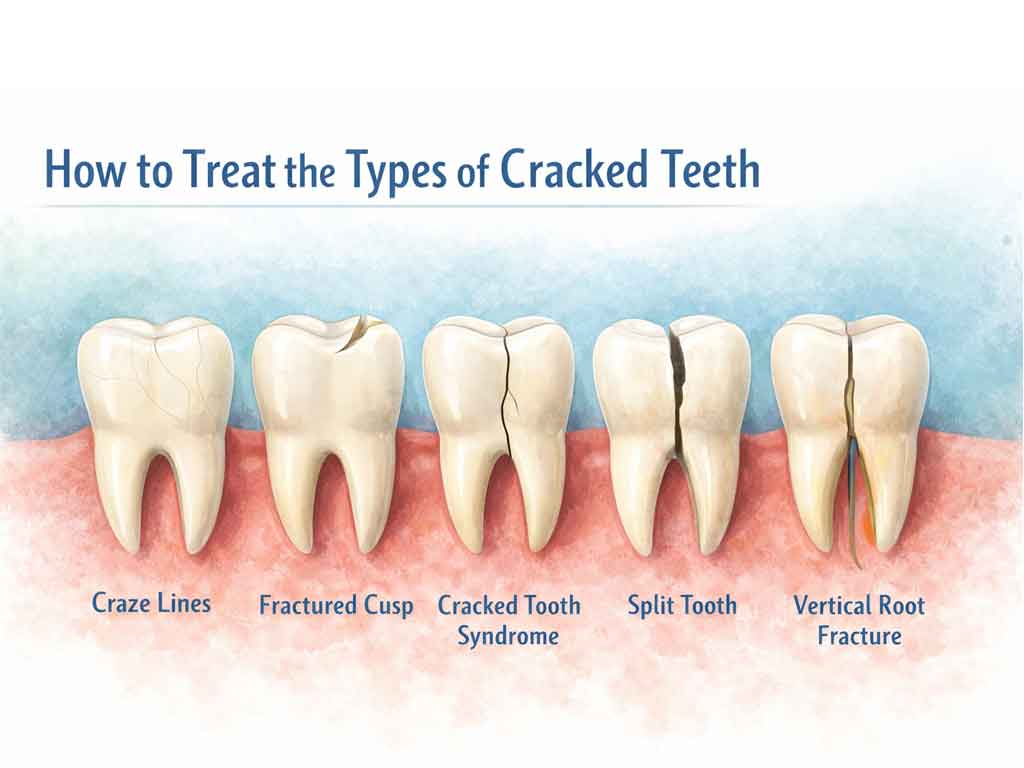
According to the ADA and contemporary literature, cracked teeth fall into five main categories:
1.Craze Lines

- Superficial enamel cracks
- No structural compromise
- Asymptomatic
Treatment: No operative intervention; monitor.
2. Fractured Cusp

- A cusp separates due to underlying structural weakness
- Often associated with older restorations
- Pain on biting or cold possible
Treatment: Depending on remaining tooth structure:
✔ Direct composite onlay
✔ Indirect composite or ceramic onlay
✔ Adhesive reinforcement (IDS + CDO protocols)
Traditional full crowns are often unnecessary when adhesive techniques are used properly.
3. Cracked Tooth (Cracked Tooth Syndrome – CTS)

- Incomplete crack extending from the occlusal surface toward the pulp
- Classic symptoms: sharp pain on biting, release pain, cold sensitivity
- Not yet split (this is the danger zone)
Treatment Objectives:
- Stop crack propagation
- Reinforce remaining tooth structure
- Preserve vitality if possible
Modern adhesive approach:
- Immediate Dentin Sealing (IDS)
- Cavity Design Optimization (CDO)
- Deep Margin Elevation (DME) when needed
- Adhesive indirect restorations (composite or ceramic overlays)
- High-viscosity composite luting for maximal reinforcement
This is where the traditional approach of “crown everything” is outdated. Adhesive overlays can re-establish biomechanical integrity with much less removal of sound tissue.
4. Split Tooth

- The crack is complete: two distinct segments
- Usually non-restorable
Treatment:
✔ Extraction
✔ Implant or prosthetic replacement planning
5. Vertical Root Fracture

- Originates in the root
- Often associated with endodontically treated teeth
- Radiographic findings: J-shaped lesion or halo
Treatment:
✔ Extraction of the fractured root
✔ Depending on the case: implant, periodontal surgery, or prosthetic solutions
2. Why Cracked Teeth Require a Biomechanical Approach & Not a “One Material Fits All” Solution

Cracked teeth fail not because the dentist chooses the wrong “restoration,” but because the biomechanics of the tooth are not properly restored.
Key biomechanical drivers of failure include:
- Loss of marginal ridges
- Deep cracks into dentin
- Occlusal overload or parafunction
- Polymerization shrinkage stresses
- Endodontically induced structural loss
Modern adhesive dentistry allows us to restore lost stiffness, redirect forces, and preserve vitality, but only if protocols are followed precisely.
This is the foundation of Didier Dietschi’s adhesive philosophy:
- Preserve, reinforce, and mimic natural biomechanics.
3. Treatment Strategies for Each Crack Type
Below is a quick, practical overview you can use in daily practice:
Craze Lines
→ No treatment.
Fractured Cusp
→ Direct composite onlay OR indirect composite/ceramic onlay
→ IDS + reinforced cusp coverage
→ Preserve maximum tooth structure
Cracked Tooth / CTS
→ Stabilize and protect remaining dentin
→ IDS + CDO + DME as indicated
→ Adhesive indirect overlay (composite or ceramic)
→ Avoid posts whenever possible
→ RCT only if symptoms or pulpal involvement demand it
Split Tooth
→ Not restorable → Extract
Vertical Root Fracture
→ Usually extraction
→ Multidisciplinary evaluation for replacement
4. Why Adhesive Techniques Are Transforming Cracked Tooth Treatment

Traditional full crowns were once the default for CTS and fractured cusps.
Today, biomimetic adhesive restorations often offer superior outcomes, with:
✔ Less structural removal
✔ Better crack-stopping ability
✔ Lower endodontic risks
✔ Reduced postoperative sensitivity
✔ Higher long-term survival rates
✔ Improved esthetics
✔ Cost-effective alternatives to full coverage crowns
But achieving these benefits requires strict protocol mastery in:
- Immediate Dentin Sealing (IDS)
- Deep Margin Elevation (DME)
- Cavity Design Optimization (CDO)
- Proper composite layering
- Material selection (bulk-fill vs conventional composites vs ceramics)
- Correct adhesive systems
- Advanced cementation procedures
This is exactly where most practitioners struggle and where advanced training changes everything.
5. Want to Master Cracked Tooth Treatment? Train with the World Leader in Adhesive Dentistry

Cracked teeth are among the most complex restorative cases and treating them predictably demands more than basic CE.
Your treatment success depends on:
- How well you understand biomechanics
- How precisely you apply adhesive protocols
- How accurately you select materials
- How deeply you understand cracked and non-vital tooth behavior
This is why so many dentists attend our flagship restorative course:
Advanced Adhesive Posterior Restorations – Hands-On with Didier Dietschi, D.M.D., Ph.D.
In this 4-day immersive course, you will learn:
✔ Evidence-based management of cracked and non-vital teeth
✔ Diagnosis and classification of cracks
✔ Restorative strategies for biomechanically compromised teeth
✔ IDS, DME, CDO and full minimally invasive indirect workflows
✔ Direct composite mastery for Class I & II
✔ Adhesive protocols that eliminate post-op sensitivity
✔ Material selection and stress-reduction principles
✔ Onlay/overlay preparation & cementation
✔ Why “No Crown, No Post” is supported by modern science
Every technique taught is based on:
decades of clinical practice, long-term patient follow-ups, and the world’s most advanced adhesive restorative concepts.
This course is ideal for any dentist who wants to confidently treat:
- Cracked Tooth Syndrome cases
- Cracked cusps
- Large posterior defects
- Deep margins
- Biomechanically fragile teeth
- Non-vital teeth
- Complex restorative cases requiring long-term success
Conclusion

Cracked teeth do not have a one-size-fits-all solution.
Accurate diagnosis, a strong understanding of tooth biomechanics, and mastery of adhesive protocols are essential for predictable, long-term outcomes.
Modern adhesive dentistry allows us to stop cracks, preserve tooth vitality, and reinforce fragile posterior teeth more effectively than ever before, but only when protocols are executed with precision.
For dentists seeking to elevate their skill and confidently treat even the most challenging posterior cases, world-class training makes all the difference.
